
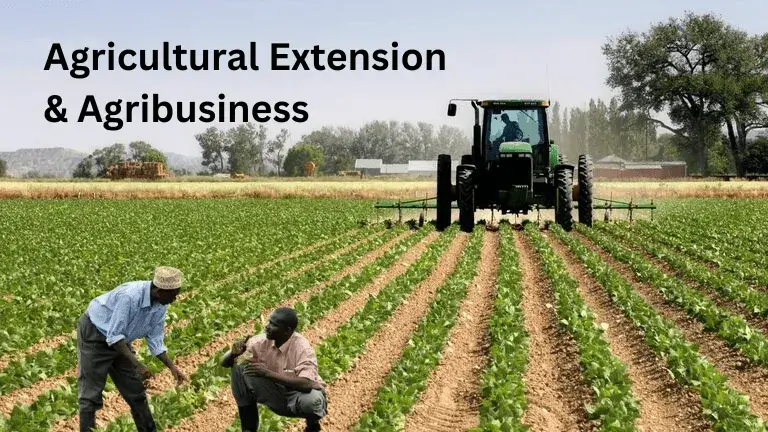
For many agricultural extension officers, the work begins and ends at the farm gate. You advise smallholder farmers on better seed varieties, soil health, pest management, and irrigation techniques. You help them grow more. But what happens after the harvest? What happens when a farmer produces twice as much maize or vegetables as last season, only to watch the surplus rot because there is no reliable buyer, no storage, and no understanding of how markets work? This is the gap that too many extension professionals are unable to help farmers cross — and it is costing rural communities dearly.
The good news is that this gap is closeable. An agribusiness management course equips extension professionals with exactly the market-side knowledge they need to complement their technical field expertise and become truly effective agents of agricultural transformation.
The Disconnect Between Production and Markets
Agricultural extension has traditionally focused on the supply side, helping farmers produce better and more. This made sense in an era when the primary challenge was food sufficiency. But today’s agricultural landscape is different. Markets are more complex, value chains are longer, and farmers increasingly need to think like entrepreneurs, not just producers.
Yet most extension officers are trained almost exclusively in agronomy, soil science, or crop production. Very few receive formal training in market linkages, pricing strategies, post-harvest handling, or agricultural finance. The result is a significant professional blind spot. An extension officer may walk a farmer through a perfect crop cycle, then have no answer when that farmer asks: “Now that I have produced it, how do I sell it profitably?”
This is not a failure of dedication, it is a gap in training. And it is one that a well-structured agribusiness course directly addresses.
What an Agribusiness Course Actually Covers
A professional agribusiness course bridges the worlds of agriculture and commerce. It introduces extension professionals to the business principles that govern how agricultural products move from farm to consumer. Key areas typically covered include:
Value chain analysis: understanding the full journey of a product from production through processing, transportation, and retail, and identifying where value is added or lost at each stage.
Market systems and linkages: learning how to connect farmers with buyers, aggregators, cooperatives, and processors, and understanding how different market systems function in rural and urban contexts.
Agricultural finance and investment: exploring how farmers and agribusinesses access credit, manage cash flow, and make investment decisions that are tied to seasonal production cycles.
Post-harvest management: understanding storage, grading, packaging, and quality standards that determine whether a product meets market requirements or is rejected.
Agribusiness planning: developing the skills to help farmer groups and small agribusinesses write business plans, set realistic targets, and measure commercial performance.
For an extension officer, these are not abstract business school concepts. They are practical tools that can be applied immediately in the field to help farmers earn more from what they already grow.
How This Knowledge Changes the Way You Work in the Field
When an extension professional gains agribusiness training, their role expands in meaningful ways. Instead of only advising on what to plant, they can now advise on what the market wants; which varieties buyers prefer, what quality standards cooperatives require, and which crops have stronger price stability throughout the year.
This market-informed approach to extension work leads to better outcomes for farmers. Studies across sub-Saharan Africa have consistently shown that farmers who receive both technical and market-side support are significantly more likely to increase their incomes than those who receive agronomic training alone. Extension officers who can speak both languages – agronomy and agribusiness – become indispensable to any rural development program.
There is also a career dimension worth noting. Development organizations, NGOs, government agencies, and international programs are increasingly looking for extension professionals who understand value chains and market systems, not just crop production. An agribusiness qualification signals that you have moved beyond the traditional extension role and are ready for more senior advisory, program management, or policy positions.
Bridging the Gap for Smallholder Farmers
Smallholder farmers face a particularly difficult version of the field-to-market challenge. They often produce in small quantities, have limited access to storage infrastructure, lack bargaining power with buyers, and have little visibility into price trends. They are vulnerable to exploitation by middlemen and are frequently unable to meet the volume or quality requirements of larger buyers.
An extension officer with agribusiness training can help address each of these challenges practically. They can facilitate the formation of farmer groups and cooperatives to aggregate produce and improve bargaining power. They can advise on quality and grading standards so that farmers meet buyer requirements consistently. They can help farmer groups develop simple collective business plans and connect them with agricultural finance institutions.
In this way, agribusiness training does not just benefit the extension officer, it multiplies through to every farmer they work with.
Taking the Next Step in Your Extension Career
If you have spent years in the field building technical expertise and you are ready to deepen your impact, an agribusiness management course is one of the highest-value investments you can make in your professional development. It does not replace your agronomic knowledge, it supercharges it by giving you the commercial tools to make that knowledge translate into real farmer income.
Professional development courses in agribusiness are now accessible to extension officers working in remote areas without the need to travel or take extended leave. Many are structured to be completed alongside full-time work, with flexible schedules that respect the seasonal demands of the agricultural calendar. There is also the option of attending the course in person allowing the extension officer to interact with the trainers and fellow trainees in person so as to gain the most benefit from the sessions and build connections that may prove useful throughout their careers.
The field will always need skilled extension officers. But the farmers you serve need those officers to walk with them all the way to the market, not just to the farm gate.
Explore our professional development courses in Agricultural Extension and Agribusiness to find the right program for your career stage.